
The giant planet, Jupiter, and its satellites orbit the Sun at a distance about 5.2 times the distance from the Earth to the Sun. Jupiter’s four large satellites were first seen by Galileo in 1610. The paradigm-shifting discovery of objects orbiting a celestial body other than Earth eventually disrupted the geocentric view of the universe in favor of the heliocentric (Sun-centered) model, with great religious and scientific consequences.
The four large satellites of Jupiter are called the Galilean moons in honor of Galileo. In order from Jupiter (and shown below from left to right), they are:
- Io, the most volcanically active body in the Solar System, with a distinctive colorful surface.
- Europa, an ice-covered world that likely harbors an ocean over 100 miles deep, and perhaps life.
- Ganymede, a rock and ice body with some “groovy” bright terrains that appear to be much younger than its darker, heavily-cratered regions.
- Callisto, an old body that is reminiscent of Earth’s Moon but with strange craters that betray its icy nature.
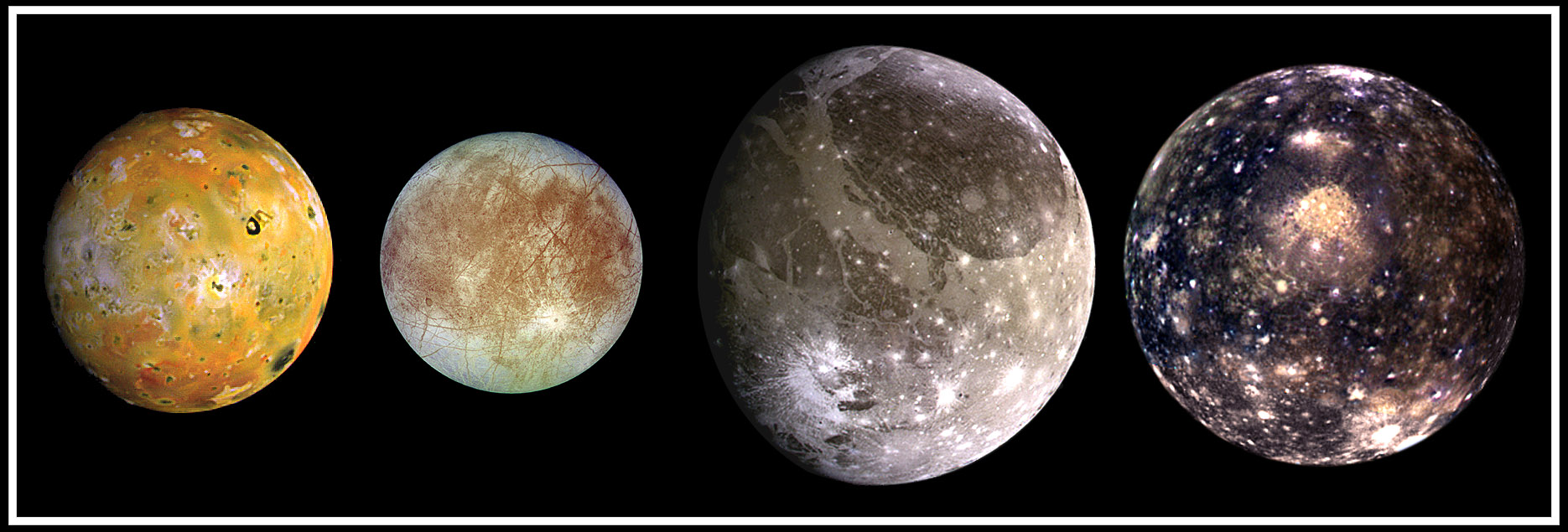 Image credit: NASA
The four Galilean satellites resemble a miniature solar system, and are thought to have condensed out of leftover material surrounding Jupiter in much the same way as the planets condensed out of leftover material in the disk surrounding the young Sun. These moons display a gradation in composition and density due to the influence of tidal heating from Jupiter, which decreases with increasing distance.
- Io is rocky, has a high-density, and is almost water-free Io.
- Europa has a thick layer of ice and liquid water over a rocky interior.
- Ganymede has a thick water ice mantle over a large rocky/metal core.
- Callisto has a much lower density, which implies a larger portion of ice. In fact, Callisto may not be completely differentiated and could have a mixture of rock and ice throughout.
Continue reading: Tidal Heating


