
Models of Europa’s gravitational field show that Europa possesses a surface layer, about 100 km thick, made of material with the density of water. Beneath the surface lies a rocky interior and a metallic core. The surface layer is predominantly H2O, but since the densities of solid ice and liquid water are very close, gravity models cannot distinguish between the two. Given the extremely low temperatures at Europa’s orbit, the surface is kept at a chilly ~100K, the ice at the surface is definitely frozen. The depth to which this ice layer extends, and whether it becomes liquid before reaching the rocky interior, is a major open question for scientists.
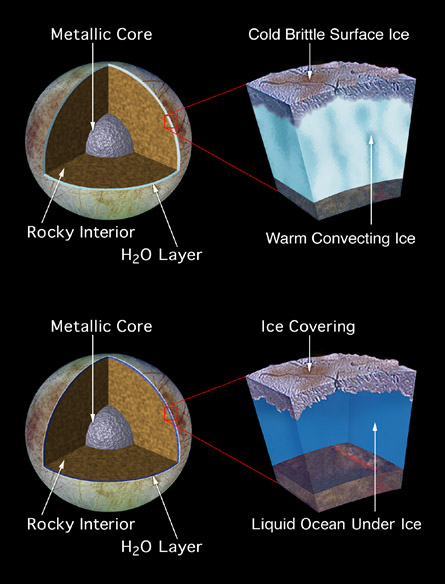
Thermal models include sources of heat and methods of cooling, and attempt to determine the thermal gradient and state (solid or liquid) of subsurface materials. In the case of Europa, these models include heating from tidal dissipation and radiogenic sources, and cooling due to conduction and convection of heat. Radiogenic heating is caused by the decay of long-lived radioactive isotopes that were incorporated in Europa when it formed, or brought to it through impacts after formation. Conduction is the direct transfer of heat from warmer to cooler regions, while convection is heat transfer due to motion of materia; warmer materials move upwards, and cooler materials move downwards. Both conduction and convection result in the transfer of heat from Europa’s warmer interior to its frigid surface, and the net cooling of Europa as a result.
For Europa, thermal models that include all of these effects have been unable to prove – or disprove – the existence of a subsurface ocean. Some models have predicted that convection would remove all the heat from a liquid layer, resulting in Europa being frozen solid rather quickly. Other models have predicted that it would be difficult to produce enough heat to melt a solid ice layer into water, but that if a water layer existed there would be enough heat to maintain it as liquid indefinitely, due to a balance of cooling and heating sources.
There are still a number of unknown quantities in these models. For example, tidal heating is the most important heat source at Europa, but also the most poorly known. It is strongly affected by the rheology of ice, which is its behavior when pushed, pulled, or squeezed. However, the rheology of ice is difficult to study under conditions similar to Europa, since Europa’s surface temperature is a chilly 100K! It is also hard to study ice being stretched over the long periods associated with Europa’s tidal cycle; laboratory measurements are easier to make over time periods of seconds, not days.
We also don’t know enough about the composition of the ice on Europa. Most models assume that it is pure water ice, but even a small amount of another material could dramatically alter the rheology of Europa’s ice. Observations suggest that, indeed, other volatiles like ammonia or salts are present. Most models also assume that the ice layer is solid, but the rheology could change if the ice layer is broken or fractured, or if the grain size is different than assumed in the models.
So in addition to the geological evidence, thermal models provide one more tantalizing, yet insufficient, clue to Europa’s subsurface structure. Water could be present, but is not required. Fortunately, however, we have some more definite evidence for subsurface water on Europa. It comes from an unlikely source: magnetic field measurements.
Keep reading: Magnetic Field Measurements
Image credit: NASA


