
Based solely on geology, we could only say that a liquid ocean at Europa is possible. The geological evidence is tantalizing, but incomplete – it suggests that liquid water could be present, but also allows for the possibility that the strange features we see on Europa’s surface formed through the motion of soft ice, without an ocean at all. The interior models present a similar conundrum – we know that there is about 100 km of material with the density of water at Europa’s surface, but can’t be sure if it’s completely solid, or if some (or most!) of it is liquid.
However, a separate line of evidence from another source, interactions between Jupiter’s magnetic field and Europa, suggests that the “possible” should be replaced with “probable.” In fact, based on these measurements, it is now widely accepted that Europa has a liquid ocean beneath its icy surface.
Europa has no magnetic field of its own, but Jupiter has a very strong magnetic field. The Jovian magnetosphere is gigantic–it is the largest “object” in the solar system, which can extend past the orbit of Saturn. Its intense radiation belts and inner magnetosphere extend out to about 10 Jupiter radii (RJ), between the orbits of Europa (9.4 RJ) and Ganymede (15 RJ). That means Io and Europa orbit within Jupiter’s radiation belt, and all of the satellites are within its magnetic field. Like most dipolar fields, Jupiter’s magnetic field is not symmetric around the center of Jupiter, in fact the magnetic field axis is tilted by almost ten degrees with respect to Jupiter’s spin axis. Because of this tilt, as Jupiter rotates, Europa experiences time-varying magnetic fields over a time period of 11.23 hours. The field also varies as Europa orbits around Jupiter every 3.5 days, but the forcing at Jupiter’s rotational period (and thus the rotation of its magnetic field) is a much stronger effect.
Data from Galileo‘s magnetometer, an instrument which measures the strength and direction of magnetic fields, showed that Europa has an induced magnetic field, which varies in direction and strength in response to Europa’s position within Jupiter’s strong magnetic field. The periodic variation in direction shows that the field is not due to a permanent internal dipole, meaning that the field is not created in the interior of Europa (unlike the Earth’s magnetic field). From the laws of electromagnetism, a time-varying magnetic field will induce an electric field in a conducting medium. The observations from Galileo indicate that an electric field within Europa causes a current to flow within the interior of Europa, with a direction that changes depending upon the direction of Jupiter’s magnetic field. This current loop then creates a secondary magnetic field with a direction that’s approximately opposite to the primary magnetic field from Jupiter. This is called an induced magnetic field.
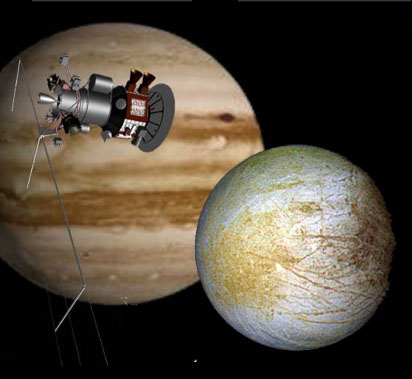
The strength and response of the induced field at Europa can tell us about its subsurface structure. The measurements from the Galileo magnetometer require a near-surface, global conducting layer. The most likely layer that meets these requirements is a global layer of salty water, with a salt content of no less than ~0.02 times the salinity of Earth’s oceans. The magnetometer results allow a range of solutions with different values for the conductivity of the ocean, the depth below the surface at which it is located, and the ocean layer’s thickness. For example, if we assume a Europan ocean with a conductivity equal to that of the terrestrial oceans, then such a layer would have to be at least several kilometers thick and located no farther than 200 km below the surface of Europa.
The Galileo spacecraft’s magnetic field data put a substantial set of constraints on Europa’s subsurface structure. The data cannot be explained by localized pockets of salty water because ions in solid ice would be insufficiently mobile to allow a current to flow through the moon’s interior. Instead, Europa must possess a complete spherical shell of liquid water.
It is possible that a type of conducting layer other than a global salty ocean could account for the induced magnetic field, but the ocean explanation appears the most plausible. In particular, the strength of the observed induced field is not consistent with currents induced in a metallic core; the induced dipole field strength falls off with the cube of the distance and the core is simply too far away to provide the observed field. The data are also not consistent with a field induced in Europa’s ionosphere; the ionosphere is too tenuous to support the electrical currents needed to explain the strength of the field. A subsurface layer of a different conducting material, instead of salty water, is possible, but such layers (such as graphite) would be implausible given what we know about Europa’s composition and formation.
Intriguingly, Galileo magnetometer data suggest that Callisto and Ganymede also harbor subsurface oceans. However, their oceans likely exist in a layer sandwiched between two layers of water ice, so they would not provide the astrobiologically more interesting rock/water interface (with possibilities for hydrothermal vents) that may be present at the bottom of Europa’s ocean.
The magnetic field results for Europa, therefore, provide our best evidence for the presence of liquid water beneath Europa’s icy surface. Such results, while intriguing, will not be confirmed until a direct detection of Europa’s ocean is made. Such measurements will require dedicated instruments on a spacecraft visiting Europa. These measurements include altimetry, high-resolution gravity, and radar sounding, and the Europa Clipper mission would include instruments to make these, and other, critical measurements.
Keep Reading: The Europa Clipper Mission
Image credit: NASA


