
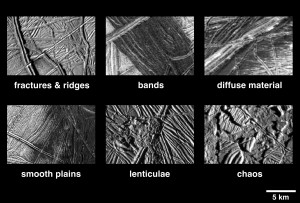
 As we’ve seen so far, the presence of strong tides should maintain a liquid water ocean within Europa. Observational evidence also supports this conclusion. The Voyager spacecraft took the first close-up images of Europa in the late 1970’s. Before Voyager, little was known about Europa’s surface except that it was very bright, and measurements taken from spectrometers on Earth-based telescopes suggested that there could be water. The Voyager images of Europa revealed a surface covered with crack-like features and very few impact craters. The lack of craters was surprising because all bodies in the solar system are continually hit by debris, which would result in a pockmarked surface like the Moon’s unless geologic activity takes place to remove craters from the surface. The lack of heavily-cratered terrains on Europa means that the surface is young, perhaps as young as a few tens of million years. To put that in perspective: 65 million years ago, dinosaurs roamed the Earth, and Europa had a completely different surface than we observe today.
Image credit: Cynthia Phillips / NASA
Images of Europa, taken decades later by the Galileo spacecraft, revealed surface features that are consistent with the presence of liquid water beneath Europa’s surface. Europa’s surface is primarily covered by a vast set of interconnecting cracks and ridges. These cracks likely form as the ocean changes shape, in response to Jupiter’s strong tides. The icy crust is too brittle to deform as quickly as the ocean, so instead, it cracks. In order to generate a large enough tidal response to create the cracks, Europa must have had a liquid water ocean at least during the time when the cracks formed. Whether the ocean, and the geologic activity it creates, persist today is an open question.
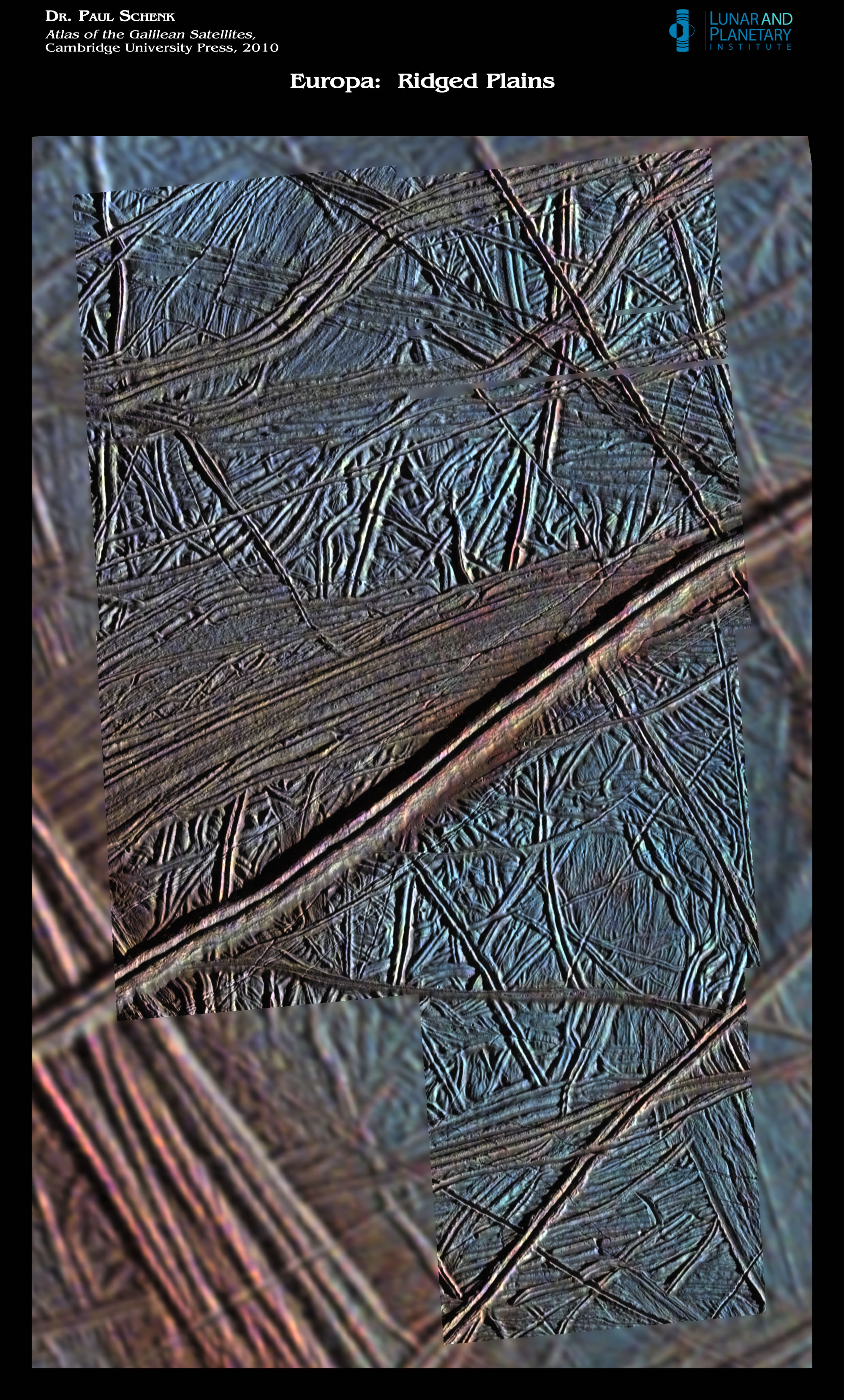
Also present are areas of disrupted “chaotic terrain”, where the surface appears to have been broken up into coherent iceberg-like blocks that floated into new positions. Such areas can be reconstructed by fitting the preexisting features on the blocks back together like pieces of a jigsaw puzzle. Other features of interest on Europa’s surface include possible surface flows and impact craters that are anomalously shallow.
Chaotic terrain was first seen as a “smoking gun” for the presence of liquid water beneath Europa’s surface, but formation models that involve only solid materials are also possible. At the “thin shell” end of the spectrum, regions of chaotic terrain are seen as areas of localized heat flow where a few-km ice layer melted all the way to the surface. In this model, the blocks are buoyant remnants of the preexisting icy crust that move about in a slushy matrix formed on top of the ocean. Eventually the matrix freezes solid, ending the blocks’ motion and preserving their final positions. This model requires localized heating of the crust, but it is difficult to concentrate enough heating in both space and time to melt through the ice in the cold ~100 K surface temperatures. A solid-state formation model suggests, instead, that warm ice rises to the surface in a diapir, eventually disrupting the brittle surface with a small amount of melt. These convective upwellings make it difficult to tilt the blocks as observed, however. A variant of this model suggests that runaway melting within rising diapirs produces chaos.
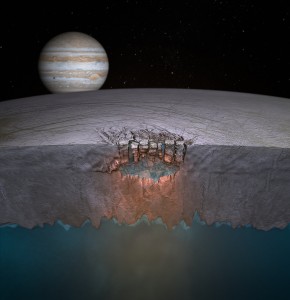
Most recently, it has been proposed that chaos forms above liquid “lakes” trapped within the ice shell formed by rising warm ice melting the ice above it, possibly explaining how “melt-through” observations could occur in a thicker ice shell. Thus, models of chaos formation do favor the existence of either water or an ice-water slurry at shallow depths near the surface, but such patches could be localized and not require the existence of a global liquid ocean layer.
The geology of Europa provides some tantalizing clues that liquid water may be present beneath Europa’s icy surface. However, images of the surface cannot prove the existence of liquid water. Fortunately, some other types of geophysical evidence do provide more definitive detections of water, such as thermal models and magnetic field measurements.
Keep reading: Probing Europa’s Interior


