
Europa is locked in a tidal resonance with its neighboring satellites, volcanic Io orbiting closer to Jupiter and groovy Ganymede orbiting farther away, such that for every two times that Europa orbits Jupiter, Ganymede orbits once, and Io orbits four times. This resonance keeps the satellites from adopting perfectly circular orbits, causing a forced eccentricity that varies their distances from Jupiter.
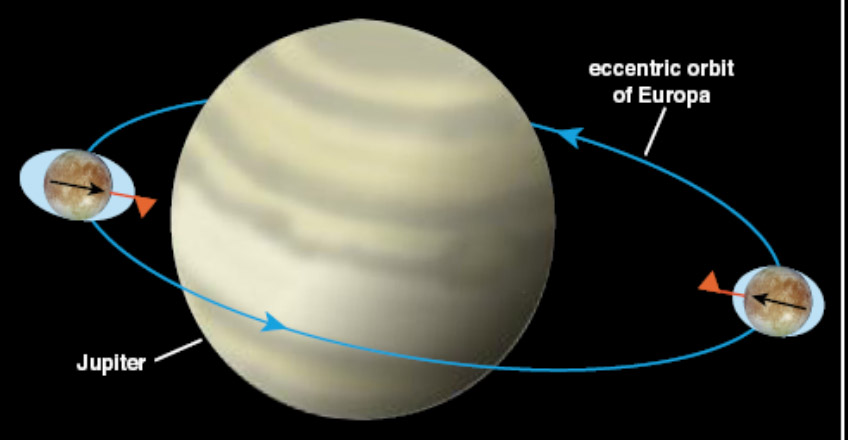 Like each of the Galilean moons, Europa is spin-locked to Jupiter, rotating about its pole in the same amount of time it takes to complete one orbit: 85 hours, or a little over 3.5 Earth days. That means Europa always shows the same face to Jupiter, just as we Earthlings only see one side of our moon. Jupiter’s strong gravity raises tidal bulges that elongate Europa in the direction of Jupiter, but Europa’s eccentric orbit causes the distance to Jupiter to vary. That means the height of the tidal bulges also vary throughout its orbit. The variation in tidal amplitude results in tidal flexing as Europa is squeezed and stretched by Jupiter’s gravity, producing an internal dissipation of energy called tidal heating.
Tidal heating is most intense at Io, due to its proximity to giant Jupiter, and results in constant volcanic activity on the small moon. In fact, Io is the most volcanically active body in the solar system, surpassing even Earth, and any water once present there has long since been driven off. Europa is further out than Io, so Jupiter’s reduced gravitational pull generates less tidal heating. However, it is still sufficient to keep a subsurface layer of water liquid over the age of the solar system. Ganymede is also subject to tidal heating, although to a lesser extent than Io and Europa given its larger distance from Jupiter. Callisto does not participate in the resonance with the other three Galilean satellites, and its surface resembles Earth’s Moon – it is an old, cratered body with few, if any, signs of geologic activity. It is possible that Ganymede, and perhaps even Callisto, possesses a deeply-buried liquid water layer, but any such ocean is much farther below the surface than Europa’s. On Ganymede, this ocean is likely sandwiched between two ice layers rather than ice and rock preventing the kinds of sea floor water-rock reactions that happen on Earth and possibly on Europa from happening on Ganymede.
Due to tidal heating, a substantial amount of heat is dissipated within Europa’s core, mantle, and ice shell. Scientists are still debating exactly how much heat is tidally dissipated within Europa, and where exactly this heating takes place: near the surface, at the ice/water interface (if there is one), within the silicate or at the water/rock or ice/rock interface at the bottom of the ice layer. Additional data would help scientists answer these questions, and help determine the potential for an alien biosphere under Europa’s icy shell.
Keep reading: Observational Evidence for an Ocean
Image credit: NASA


