Uncategorized

Destination: San Francisco!

By: Alyssa Rhoden

The fall meeting of the American Geophysical Union (AGU) is a monster of a conference. Held annually in San Francisco, the meeting draws more than 20,000 attendees and holds over 500 sessions every day. With so much activity, one would expect these sessions to cover anything and everything geoscience. Sadly, however, there hasn’t been a Europa-specific session at AGU in years.

We, at Destination: Europa, thought it was high time to showcase our favorite moon as well as the novel and noteworthy science being cleverly wrangled out of our limited data. We proposed an AGU session on Europa and received 32 abstracts, enough for both an oral and poster session.

Reading through the abstracts, the breadth of Europa science being conducted, all over the world, blew us away. Although it was difficult to select only 11 abstracts for our oral session, we did our best to make it the most diverse and exciting Europa session on record.

Cracking Europa.

image

This medium resolution image, with high-resolution inset, shows numerous overlapping fractures, bounded by ridges, chaos features (small, bottom right and larger, top left) and several pits an uplifts (top left). Although much of Europa’s geology can be explained by tidal stress and heating, due to Europa’s eccentric orbit, an additional mechanism is needed to explain pits and uplifts, a subset of fractures, and balance new surface area added at dilational bands. New work, presented at AGU, will help scientists solve these puzzles and better understand this icy, ocean moon.

Several researchers presented work in which they mapped and measured geologic features on Europa’s surface in order to understand its resurfacing history. Europa’s geology is made up of two broad classes of features; in global imagery of Europa, they appear as lines and spots. The lines are thought to be fractures and include hairline cracks, barely visible on the surface, prominent pairs of parallel ridges, and all stages in between. Regional and high-resolution images have revealed that spots encompass a wide variety of features. Chaos terrains are regions of broken-up surface material, perhaps formed when the outer portion of the shell collapsed into a shallow lake below, and then refroze. Pits and uplifts have also been identified, which have proved challenging for scientists to explain.

A new survey of pits, uplifts, and small chaos features, presented by Kelsi Singer, who recently received her PhD from Washington University in St. Louis, has revealed some interesting characteristics. Despite a thorough search, Kelsi was not able to identify any features smaller than 2.3 km across. Also, the heights of features – above the surrounding terrain for uplifts and below for pits – correlated strongly with their widths. Scientists can now use these characteristics to test models of the formation of pits, uplifts, and small chaos regions.

The most tantalizing result from these geologic studies was the identification of bands that correlate with a loss of surface material over time, which was presented by Simon Kattenhorn from the University of Idaho. In a process analogous to terrestrial plate tectonics, it appears that large portions of Europa’s surface have been subducted into the warmer ice below. If confirmed through continued analysis, Kattenhorn and his coauthor, Louise Prockter, may have solved a long-standing issue with balancing Europa’s budget – surface area budget, that is.

In many regions of Europa, scientists have identified dilational bands – fractures that were pulled apart over time, with new material rising up to fill in the gap. Similar to spreading centers on the Earth, these dilational bands represent an increase in Europa’s surface area that must be balanced by a loss of area elsewhere. Europa scientists have been looking for evidence of convergence, or subduction, for decades. A few convergence bands have been identified, but they are likely too sparse to independently offset the observed dilation. Another speaker in our session, undergraduate student Cansu Culha, from UC – Berkeley, identified both contraction and dilation along ridges. However, the contraction was, again, only a small fraction of what would be needed to balance the observed dilation. Adding in the bands identified by Kattenhorn and Prockter, however, may do the trick.

The mechanics of Europa’s plate tectonics are not yet understood. For example, we don’t know whether plate motion is driven by the opening of fractures or by the subduction process itself. Actually, the same questions are being debated for Earth! Identification of plate tectonics on Europa thus offers us an opportunity for comparative planetology – studies that compare processes across multiple solar system bodies. Unfortunately, the sparseness of data at Europa makes widespread identification of these so-called subsumption bands unlikely. Rather, it will take a new mission to gather enough data to identify Europa’s plates and determine the extent to which plate tectonics plays a role in Europa’s surface history.

Eat me, Earthlings.

Another important implication of a plate tectonics style process operating on Europa is that it would mix material from the surface and subsurface, a key element for habitability. Mixing within the ice shell may also be driven by small-scale melting and freezing at the ice-water boundary, leading to compositional differences in the the ice that can drive inter-ice plumes. As Divya Allu Peddinti, a graduate student at Arizona State University, explained, evidence of mixing may even be preserved on Europa’s surface, detectable by future compositional analysis of the ice.

To give us a better understanding of whether Europa can support life, Tori Hoehler, an exobiologist at NASA Ames, described the role of energy. As he explained, the method by which energy is delivered is as important for sustaining life as the total amount of energy. Some mechanisms do not supply energy consistently enough, or in large enough quantities, to maintain organisms. To better understand Europa, from an astrobiological perspective, we need more laboratory investigations and models of the energy exchange processes that may be at work in Europa’s ice shell and ocean and at the boundary between the ocean and the rocky interior.

Destination: Europa!

Given that our goal is to support a new mission to Europa, we were very excited to learn what different instruments could teach us. Nick Schmerr, from the University of Maryland at College Park, investigated the potential results that seismometers could deliver if they were ever deployed on Europa’s icy surface. As Europa moves through its eccentric orbit, the ocean responds to the changing gravitational pull of Jupiter. Cracks in Europa’s ice shell correlate well with predicted patterns of stress caused by the ocean moving underneath. Whereas terrestrial earthquakes are mainly driven by the motion of crustal plates, tides should drive strike-slip motion along Europa’s faults, producing cryoquakes. Seismometers on Europa could detect the shaking induced by fault motions over time. Then, seismological techniques developed for Earth could help us probe Europa’s interior structure, further refine predictions of tidal stress, and identify small pockets of water within the ice shell.

This image, captured using the Hubble Space Telescope, is interpreted as a plume emanating from Europa's south pole. The emission was clear in this image, taken when Europa was at its farthest point from Jupiter (called apocenter) but did not appear in images taken at other times in Europa's orbit. The eruption timing is reminiscent of Enceladus' plumes, which change in intensity throughout its orbit, and suggest tidal control of Europa's eruptions.

This image, captured using the Hubble Space Telescope, is interpreted as a plume emanating from Europa’s south pole. The emission was clear in this image, taken when Europa was at its farthest point from Jupiter (called apocenter) but did not appear in images taken at other times in Europa’s orbit. The eruption timing is reminiscent of Enceladus’ plumes, which change in intensity throughout its orbit, and suggest tidal control of Europa’s eruptions. (Image credit: Retherford, et al., 2013, Science)

We also had an update from Victoria Siegel, of Stone Aerospace, on Project Valkyrie: a cryobot that they hope to someday deploy on Europa. Unlike past concept studies we’ve heard about, Stone Aerospace actually has a working prototype, which they plan to test in Antarctica this summer. For the tests, energy from lasers, sent through a fiber optic cable, will power the bot. The engineers at Stone Aerospace pioneered this technology because nuclear power, the source envisioned for use at Europa, cannot be used in Antarctica. Once deployed, the crybot will melt its way through the ice, filtering melt water through sensors in order to catch any traces of life. After penetrating through the ice layers, it will slowly execute a u-turn, and return to the surface. Our session, which ran from 4-6pm on the last day of the meeting, culminated with a video of the Valkyrie cryobot descending into a large block of ice at the Stone Aerospace testing facility. It was pretty amazing footage; much of the audience stayed late just to watch Valkyrie in action.

An eruption of enthusiasm.

The Destination: Europa session was a smashing success, but it wasn’t the only session in which Europa results were presented. And no recap would be complete without mention of the astonishing discovery of plumes emanating from Europa’s south pole. Based on analysis of images from the Hubble Space Telescope (HST), scientists identified an anomalous oxygen emission in Europa’s UV spectrum, which is best explained by two plumes, each one rising about 200-km above Europa’s surface. Interestingly, that is about the same height as the plumes observed on Enceladus. Because Europa is much larger, and has much higher gravity, Europa’s plume material must be moving much faster than on Enceladus.

Whether Europa is currently active is certainly one of the most fundamental questions unanswered by our previous, data-limited analyses. Although the plumes have only been detected once, and additional observations will be needed to confirm the results, the implications are mind-blowing. Not only would these observations prove that Europa is currently active, the detection of plumes means that the surface-subsurface exchanges so critical to life do occur and that liquid water is present at shallow enough depths to be tapped by fractures. With this evidence in hand, we could simply not justify any further delay in exploring this active, watery world, which may be the best extraterrestrial habitat in our Solar System. We need a new mission to Europa, and we hope all of you will help us get there by sharing your enthusiasm with your friends, colleagues, and most importantly, your elected officials. Together, we can make Europa our next planetary destination!

Note: Over the next few days, we’ll be chatting with the scientists who discovered Europa’s plumes. Check our blog for all the details!

==============================================================================

Want to support a future mission to Europa? Learn how to contact Congress.
Clipper mission details can be found on our Mission page and on JPL’s Clipper site.
For additional coverage of Europa science at AGU, check out the articles on The Planetary Society’s blog and NASA’s Europa blog.

Hot off the presses!

EuropaClipperInfoSheetPg1 EuropaClipperInfoSheetPg2

Top Ten People Who Could Afford their Own Europa Mission

At a cost of roughly $2.0 billion, the Europa Clipper mission will set Americans back less than a single B-2 stealth bomber, and much less than they spent on potato chips last year [1]. Nonetheless, a mission to Europa is a major investment, which is why we often assume that only a rich and powerful government could sponsor the endeavor. However, in the age of Kickstarter and commercial space flight companies, we might not be surprised if a large group of proactive and semi-wealthy Europaphiles cobbled together the funds for their own version of Clipper.

Would it surprise you to learn that there are also hundreds of individuals who could personally fund such a mission? According to Forbes Magazine’s annual list of the world’s billionaires, there are currently 736 people on the planet whose personal net worth each exceeds $2 billion. Here, we highlight our choices for the “top ten” individuals who could launch their own private mission(s) to Europa – with plenty of cash to spare.

 Infographic by Paul Hayne for Destination Europa, copyright 2013

Honorable mentions go to Warren Buffett, Bill Gates, and Carlos Slim Helu, who could afford 26, 33, and 36 Europa Clipper missions each, respectively. Together, the top five richest people on Earth could fully fund NASA (annual budget $17B) for more than fifteen years.


[1] “Rising Above the Gathering Storm, Revisited” (2010), National Academies Press. http://www.nap.edu/catalog.php?record_id=12999

Why study Europa?

WiseWords

Science from the Source (3)

SampleNugget1

With the President and NASA Missing Our Message, it’s Time to Turn Up the Volume!

By now you may have seen coverage of last year’s budget request and the sequestration and their negative effects on NASA’s Planetary Science Division (link to earlier post).  Fast forward to the Continuing Resolution for 2013, and another picture emerged: one of strong public support for NASA’s tremendous accomplishments in planetary science, and a bipartisan message from Congress that a mission to Europa should be a major priority for the agency.  The $75M included explicitly along with an overall $200M increase in NASA’s Planetary Science budget from Congress is a huge step forward in realizing the highest priority mission for the past two decades, a return to Europa (ranked equal to or separate from any Mars missions).

But the 2014 budget request showed that the Administration, and NASA, have a different idea: less money for Planetary Science and no mention of Europa anywhere to be found.  What was there? A commitment to Human Exploration, continued funding for the Space Launch System and James Webb Space Telescope, and further Mars exploration.  It’s clear: NASA and the President haven’t gotten our message.

Several key groups have weighed in on the subject.  Before the president’s budget was released, Dr. Jim Green spoke to the NASA advisory Planetary Science Subcommittee, with a message that the worst was coming—a continuation of the bleak FY2013 proposal. “We are not a protected program, we are not a high-priority program,” he said.

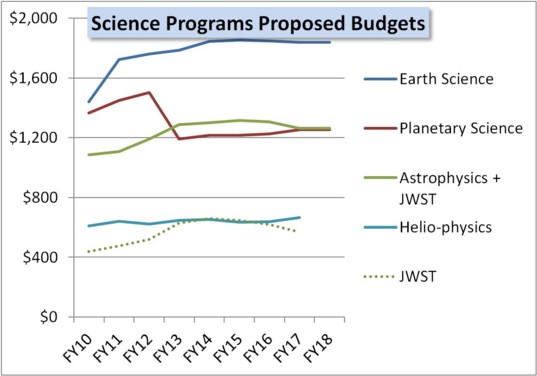
Courtesy of Planetary Society: http://www.planetary.org/blogs/guest-blogs/van-kane/20130410-proposed-nasa-planetary-science-budget.html

Europa isn’t the only destination to suffer, but the whole Outer Planets program is taking a big hit, to the tune of nearly $45M from FY2012, including cutting Europa funding and decreasing funds for the active Cassini mission at Saturn.  Discovery mission cadence is threatened by both cuts and by the sequestration.  NASA’s valuable Education and Public Outreach programs are under fire as well:  funding for teams working across the country at universities, national labs, educational organizations and NASA centers,  are being reallocated to government organizations  separated from spacecraft teams, mission science teams, and the active process of scientific and engineering achievement associated with NASA missions.  The OMB description states, “The Budget includes a bold reorganization of Federal STEM programs that uses existing resources more effectively and in a more streamlined, consolidated way.”  I can think of another word than “bold.” If this “restructuring” holds, it would be a bit like asking the University of Texas to do public relations and curriculum development for MIT.

So let’s look at what we’ve got right now: by the end of FY 2013, NASA has been required to spend $75 million on instrument maturation for Europa Clipper.  It’s unclear yet what NASA’s FY2013 operations plan will show — that’s expected out in the next month.  The possibilities include $75M spent on the instrumentation, or ~93% of $75M per the general cuts mandated by sequestration. Unfortunately, most of the increase in planetary science allocated by Congress, to the tune of $200M, could fall victim to sequestration as NASA maneuvers to keep it’s “priority” programs safe from feeling the effects of the sequester.  But for the time being, it looks like upwards of $60M may be spent getting instruments ready for Europa, most of the development for which would actually happen during FY2014.

So, here’s our new action plan to get Europa Clipper funded with YOUR HELP!

EuropaImage

1) A campaign to contact Congress that starts NOW. 

We need to:

            –Thank Congress for supporting Planetary Science, and specifically Europa!

           Ask Congress to again restore Planetary Science funding with continued Europa development, working towards a New Start

           – Ask Congress to keep watch on the $75M Europa line item in NASA’s 2013 operations plan.

2) A year-long writing campaign contacting the White House and NASA Administration.

So far, the President and NASA have not taken notice of the public and industry-wide support for a new Europa mission.  We need to make compelling arguments, based on science and societal impact for Europa to become a priority for NASA.  While the President sets NASA’s direction, he relies on advisors and staff that includes the NASA Administration and President’s Council of Advisors on Science and Technology (PCAST).  We’ve put together a list of people to contact, so please see the FY2014 Campaign HERE  for those to contact.  If we can encourage the President along with his advisors at NASA and PCAST to consider Europa Clipper as an inspiring, scientifically rich goal for NASA, we may reach the goal of a 2015 New Start!

The summary is this: the public is excited about Europa.  Congress has been on our side–they’ve listened to the public and to planetary scientists and advocated for a Europa mission on our behalf.  The President and his advisors have other priorities, but we are capable of turning the tide if we all do our part.


Let’s write our President, NASA and Congress and ask them to help us SET SAIL!


Britney Schmidt for

Destination:Europa

Science From the Source (2)

VanceGoodmanNugget

One small step for a mission…

This past Tuesday, the President signed a continuing resolution that was recently passed by the House and the Senate. The bill outlines how the government will spend its money for the remainder of the fiscal year. Included in the spending package is an increase in funding for NASA’s planetary science research program as well as $75 million for a Europa mission. Although it’s not yet clear how the money will be allocated – perhaps it will fund instrument development? – it is very exciting news for all of us at Destination: Europa.

It’s much easier to make noise when we are angry than when we are pleased, but we can’t forget to show our appreciation when people go out of their way to support our cause. So, first and foremost, we want to THANK YOU for your participation. Together with organizations like The Planetary Society and professional societies like AAS and AGU, you helped show Congress that the American people support outer solar system science!

And just as we acknowledge the vital role that you all played in getting the Europa mission into this bill, we are asking each of you to contact your Senators and Representatives to thank them for supporting the Europa mission.

The bill authorizes: “That $75,000,000 shall be for pre-formulation and/or formulation activities for a mission that meets the science goals outlined for the Jupiter Europa mission in the most recent planetary decadal survey” – H.R. 933, p. 64

A thank-you letter to the President, written by one of our founding members!

A thank-you letter to the President, written by one of our founding members!

The members of the committees on science and space-related policy are listed at “Europa Goes To Congress”. If these are your elected officials, please give them a call or even mail them a thank-you card! You may also want to thank your Senators or Representatives who voted in favor of the bill (links go to voting records). If your elected officials voted no, it is especially important that you let them know that you support funding for Europa! Last, but not least, we need to thank the President for signing this legislation into law.

Although he has been an ardent supporter of STEM careers and has often spoken of returning America to the cutting edge of technological innovation, President Obama’s initial budget request would have held NASA’s budget flat while saddling planetary science with a 20% reduction in funding. Meeting those budget constraints would have required massive cuts to R&A, a longer waiting period between smaller space missions, and no funding for any strategic missions, including the Europa mission. The passage of this bill shows that, when the public is vocal and passionate about a cause, Congress and the President listen.

We have made terrific progress towards restoring NASA funding to operational levels, but there is more work to be done. Fiscal planning for the coming year kicks off with the President’s budget request, which he is expected to release in the first week of April. That means NOW is the time to be vocal and passionate in your support of Europa Clipper. Please take the time to write or call the President and your Senators and Representatives, both to thank them and encourage their continued support for Europa science and the Clipper mission in the 2014 budget.

The tide is turning, but we need you to hoist the sails! #goEuropa!

Science From the Source (1)

Nugget_Rhoden

A New Start for Europa: Visions and Challenges

At some point in our lives, most of us have gazed up at the multitude of stars in the night sky and felt captivated by the possibility of exploring distant worlds. But have you ever thought about where you would explore if you had the chance? NASA recently gave planetary scientists the opportunity to ponder this question as they developed guidelines for the next ten years of robotic space exploration. Called the Decadal Survey for Planetary Science, the resulting “Visions and Voyages” document represents the consensus view of the hundreds of planetary scientists who participated. NASA attempts to follow these science-driven guidelines in assembling a portfolio of future missions to explore and study the solar system.

The top priority target for NASA’s next big mission? Two candidates surged to the top, earning equal scientific clout: A sample-collecting Mars rover and a flagship-class mission to Jupiter’s ocean-moon, Europa. At Mars, after securing precious samples of the Martian crust, the rover would await two subsequent missions to collect and return them to Earth for study in today and tomorrow’s most advanced laboratories. The goal: to determine whether life ever arose on the Red Planet. The Europa flagship mission would be the first to orbit an extraterrestrial moon and would use instruments such as ice-penetrating radar and an infrared mapping spectrometer to investigate the habitability of the icy shell and subsurface ocean. Judging by the spectacular results of the flagship Cassini mission to Saturn, we could expect nothing less than awe inspiring new vistas and scientific surprises galore. Furthermore, a dedicated Europa mission would pave the way for more advanced forays, such as landers with seismometers for measuring Europa-quakes or even a submersible rover to explore the vast under-ice ocean. Two visionary space missions, engineers and scientists ready to start work, and strong public support – a slam-dunk for NASA, right?

BudgetPlot

Figure 1: Projected budget for NASA’s Planetary Science Division as a percentage of the overall NASA Science budget. Source: NASA

Things started to go wrong when the White House released its FY’13 budget early last year, in which NASA’s Planetary Science Division – the one responsible for those cool robotic missions – was handed a 21% funding cut. Many planetary scientists were taken aback by the severity and specificity of the cut in light of NASA’s relatively unchanged overall funding, and the string of recent high profile successes, such as the Mars Exploration Rovers, Cassini, and the Messenger mission to Mercury, to name but a few. With this new funding reality on the horizon, it became clear that NASA would not be able to follow the Decadal Survey recommendations and collect samples from Mars, and we certainly wouldn’t be exploring Europa any time soon. Delays and cuts of this kind propagate for years into the future, due to the long process of designing, building, and launching interplanetary spacecraft.

Just after the Curiosity rover made its harrowing descent into Gale crater  last August, Congress seemed to take notice and added about $100M back into the proposed budgets, with the funds earmarked for future robotic Mars exploration. Europa would continue to wait patiently. Meanwhile, scientists and engineers were not waiting: they were busy reworking the Europa flagship mission concept, making difficult choices and streamlining the design to bring the cost down while protecting the most compelling science. The Europa Clipper fly-by mission concept was born. Coming in at about $2B, the Clipper mission could accomplish nearly all of the scientific goals of the Europa Flagship, at roughly half the cost.

What would it take to get Europa Clipper off the ground? We have the technology. Engineers and scientists are ready to start work. All that is missing is the funding for a “new start”, which would amount to a small fraction of NASA’s overall budget. Convincing Congress and the White House may not be easy, but we have to start somewhere. This is where you come in: If you have ever stared up into the vastness of space and wondered where you might go, this mission is for you. We need your help!

BudgetFig